When we look up at Michelangelo’s The Creation of Adam, humanity appears infinitely small, yet at the same time inexplicably noble. On the ceiling of the Sistine Chapel, the fingertip of God reaches toward Adam, while Adam’s hand, not yet fully touching His, waits for the moment of life. In that brief gap lies not the story of humanity reaching God by its own power, but the mystery of grace in which God first draws near to humanity.
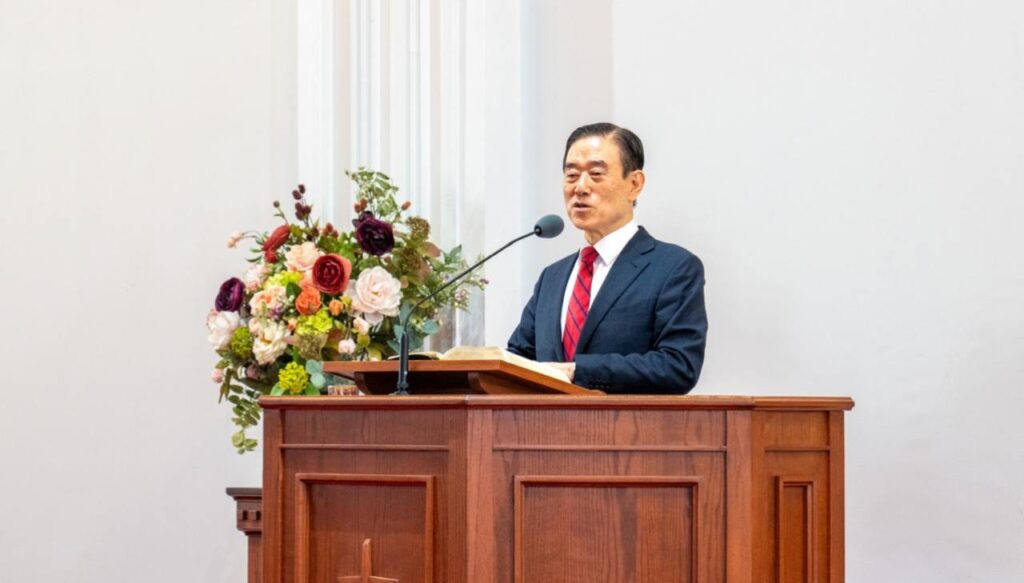
The gospel proclaimed in Colossians 1 begins precisely there. Paul introduces himself as “Paul, an apostle of Christ Jesus by the will of God.” This is not merely the opening sentence of a letter. It is a theological declaration that reveals where the church and believers come from, upon whose will they stand, and for what purpose they have been called. This is also the central point held by the sermons on Colossians preached by Pastor David Jang, founder of Olivet University in the United States. The church is not built upon human enthusiasm or organizational ability, but upon the will of God and the calling of Jesus Christ.
When the Calling Is Lost, the Church Loses Its Direction
Paul addresses the church in Colossae as “faithful brothers and sisters in Christ.” The Colossian church was not a church Paul had personally founded, yet it was a community that shared the same life in the gospel. This fact shows that the essence of the church does not lie in the influence of a particular person or the size of a region. The church truly becomes the church when it stands upon the truth of the gospel.
The reason today’s church often wavers can also be found here. Before asking what more it should do, the church must first ask why it exists. Even when programs are many and activities are lively, if its identity becomes blurred, the church turns into an organization no different from the world. On the other hand, even if it appears small and weak, a community that knows who it is in Christ does not easily collapse.
At this point, Pastor David Jang strongly emphasizes the identity of believers and the church. If the question, “Who am I, and for what purpose have I been called?” is not clear, faith can easily be swept away by emotions or atmosphere. But when there is the conviction that one has been called by the will of God, faith becomes the center of life, and obedience becomes not a burden but a direction.
Faith, Love, and Hope Give Breath to the Church
Paul says that whenever he prays for the church in Colossae, he gives thanks. The reason for his thanksgiving is their faith, their love for all the saints, and the hope stored up for them in heaven. Faith, love, and hope are not merely beautiful religious expressions. They are evidence that the gospel is truly alive and moving within a community.
Faith is the strength that holds fast to Christ. Love is the way that faith flows toward others. Hope is the conviction that present suffering and confusion do not have the final word. When these three are alive, the church gains depth beyond outward appearance and life beyond size. Conversely, when these three grow weak, no matter how much the church possesses, its soul begins to dry up.
The gospel does not end with hearing. Paul speaks of a life that bears fruit after hearing and understanding the word of truth, the gospel. The same is true of Bible meditation. Knowing the Word alone is not enough. The Word must pass through the heart and descend into life, and grace must move beyond thought to become the practice of love.
When Christ Becomes Small, the Gospel Becomes Blurred
At the deepest center of Colossians is the absolute lordship of Jesus Christ. Paul proclaims Christ as the image of the invisible God and the One who is before all things. This is a clear answer to every tendency that seeks to reduce Jesus to merely a great teacher or moral example. At the center of the gospel are always the cross and resurrection of Christ, and His divinity.
The moment the church loses its way is usually the moment Christ is pushed out of the center. Sometimes worldly success takes His place. At other times, human calculation and desire replace Him. Sometimes legalism obscures grace, while at other times cheap freedom weakens repentance and holiness. Colossians exalts Christ so that the church will not lose the purity of the gospel.
The theological insight emphasized by Pastor David Jang is closely connected to this flow. The church must not only confess Christ as its head, but also obey His lordship in its actual ministry, decision-making, and way of life. When worship and education, mission and service, finances and community life all come under the reign of Christ, the church finally reveals an order different from that of the world.
The Hope Stored Up in Heaven Changes Life on Earth
Even while Paul was in prison, he prayed for the church in Colossae and confessed that the gospel was bearing fruit and growing throughout the whole world. This shows that the gospel is not a local religious sentiment, but the life of God expanding toward the world. The church is not a closed refuge that remains within itself, but a community that carries the gospel and goes out into the world.
The vision of the church reflected in Pastor David Jang’s sermons is found here as well. The church is both the guardian of the gospel and the messenger of the gospel. Inwardly, it must be built up through the Word and prayer. Outwardly, it must flow into the world through love and mission. In the Holy Spirit, believers must pray for one another, share love in real and practical ways, and bear the fruit of the gospel in the world.
In the end, the question Colossians leaves for us today is not simple. Are we truly honoring Christ as the head of the church? Is our faith being revealed through love? Is our hope stored up in heaven while also renewing our lives today?
The gospel is not an old doctrine, but a living life. That life becomes understanding in those who hear it, obedience in those who understand it, and fruit in the community that obeys. This is also the path the church must hold onto again today: returning not to more splendid words, but to a deeper gospel; not to a larger outward form, but to the clearer lordship of Christ. In that quiet place of restoration, our faith once again waits for the life of grace, like Adam’s hand awakening toward the fingertip of God.